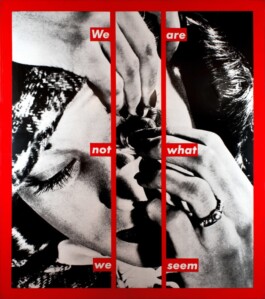
Barbara Kruger is an american conceptual artist and collagist. She has been the subject of numerous publications that analyze her impact on contemporary art, feminist theory, and visual culture. The phrases in her works often address cultural constructions of power, identity, consumerism, and sexuality. Kruger's artistic mediums include photography, sculpture, graphic design, architecture, as well as video and audio installations. She made her name creating graphic design, communication and picture editing for magazines and freelancer, also designing book and jackets. Kruger's earliest works date back to 1969, when she began creating large wall hangings which incorporated materials such as yarn, beads, sequins, feathers, and ribbons. These pieces represented the feminist reclamation of craft during this period. She then moved to Berkeley, California, where she taught at the University of California, but in 1977, she returned to work with her own architectural photographs, also publishing an art book in 1979. She was inspired to photograph architecture by her family's practice of touring "model homes they could never afford". At the beginning of her career, she reportedly felt intimidated by entering New York galleries due to the prevailing atmosphere of the art scene which, to her, did not welcome "particularly independent, non-masochistic women". She eventually switched to her modern practice of collage in the early 1980s, which made her the icon we know today. Now she is a Distinguished Professor of New Genres at the UCLA School of the Arts and Architecture.
Kruger challenges the idea that self-worth is defined by material possessions and social achievements.
Her work suggests that in a society guided by the consumer culture, "who we are" is often replaced by "what we have".

Using her signature style, she challenged patrialchal norms and criticized institutional control over yhe female body, life and career
She confronted the passive role of women in visual culture, challenging the "male gaze" and reclaming agency for women.